Rent Help 2026: Salvation Army vs. St. Vincent de Paul
Last updated:
Apply on the official site →If you are behind on rent and you have searched for help, two names come up over and over: The Salvation Army and St. Vincent de Paul. Both really do pay rent. Both are national. Both are free.
And then you hit the wall that this guide exists to remove: one of them has a search box that gives you a phone number in ten seconds, and the other one, by design, does not.

Neither organization is a government program. Both are nonprofit charities. They work alongside government benefits like LIHEAP and Section 8, which we link at the bottom — and you should be applying to those at the same time.
The Short Answer
| The Salvation Army | St. Vincent de Paul | |
|---|---|---|
| What it helps with | Rent and mortgage, utility bills, shelter, food, prescriptions | Rent, utilities, food, clothing, “other emergency needs” |
| Who is eligible | No national income limit; “assistance to all without discrimination,” in accordance with capacity | No national income limit; each conference decides |
| How you make contact | Official ZIP-code location finder → call or visit that center | Call a local conference — usually found through a Catholic parish |
| Who decides | The local service center | The local conference (about 4,000+ nationwide) |
| What happens next | You go to the center’s office with your documents | Two volunteers come to your home (a “Home Visit”) |
| Local variation | Programs and funds set per center; some units do no rent help at all | Every conference sets its own limits from what it raised locally |
| National office | Runs the finder that routes you locally | States it “does not provide direct assistance to those in need” |
The Real Difference Is the Front Door
Most articles compare these two charities on what they give. That is the least useful comparison, because the answer is nearly identical: emergency money for rent and utilities, decided locally, in whatever amount the local office has this month.
The useful comparison is how you get in the door, and there the two organizations are built on opposite models.
The Salvation Army: you find a building
The Salvation Army publishes a national location finder that takes a ZIP code, address or city and returns local units on a map. It says it operates 6,400 service centers nationwide.

We used it on August 24, 2026 to see exactly what someone in a rent crisis would get. Three things are worth knowing before you try:
- There is no “Rent” checkbox. The finder lists twenty service filters — Community Meals, Worship Services, Utility Assistance, Holiday Giving, Homelessness, Senior Services, Hunger, Poverty, Recovery, Disaster Relief and others — and rent is not one of them. The box to tick is Utility Assistance. On the result cards the very same service is written out as “Utility Rent Assistance”: one combined tag covering both. If you scanned the filter list looking for the word “rent” and concluded The Salvation Army does not do rent, that is a labeling problem, not an answer.
- The results are addresses, not a hotline. Searching ZIP 60601 with Utility Assistance selected returned 15 pages of locations, the nearest 2.4 miles away. Each card carries the unit’s own name, its “Services Offered” list, a direct phone number, a street address and hours.
- The units have names that tell you what they are. In that one ZIP the results included several “Corps Community Centers” — a corps is the local Salvation Army unit — plus a Red Shield Center and a community church. Their service lists were not identical: the community church listed family services, youth and poverty programs but not Utility Rent Assistance. Read the card before you go.
One more practical detail from those cards: several said “Hours not available” or “Contact location for hours.” That is your cue to phone first rather than show up with a folder of documents.
St. Vincent de Paul: the help finds you
The Society of St. Vincent de Paul is not one office with branches. Its national site describes “4,000+ local Councils and Conferences”, and members — called Vincentians — serve “through their local St. Vincent de Paul Conference.” A conference is usually attached to a Catholic parish, raises its own money, and decides its own cases.
There is no national ZIP-code finder for those conferences, and the national office states the reason on its contact page, in the plainest possible words:
“SVdP USA does not provide direct assistance to those in need. If you are seeking help:
- Contact your community Catholic church and ask if they have a Society of St. Vincent de Paul.
- Search the internet for ‘Society of St. Vincent de Paul’ and the name of your city/town.”
Those two bullets are the official application route. The only map link on that page is a Store/Donation Center Locator, which finds thrift shops and donation drop-offs — not the conferences that review rent requests. Thrift store profits do fund local aid, so store staff often know the conference, but the store itself is not the office.
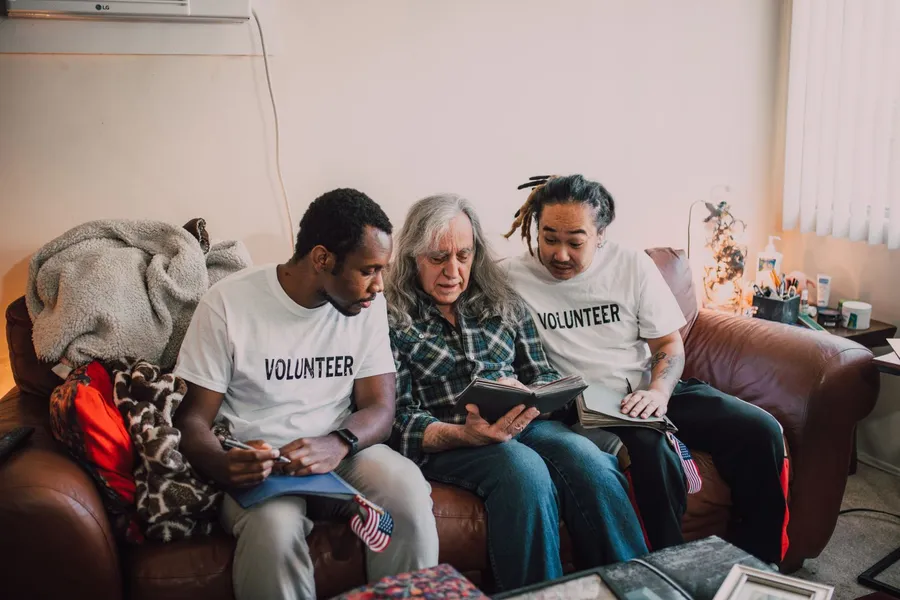
And once you reach a conference, what happens is genuinely different from any office intake. SVdP USA describes its core method, the Home Visit, this way:
“Vincentian volunteers go in pairs of two to visit individuals and families in their home that have called seeking assistance. During this Home Visit, they develop a real friendship, listen to their concerns, and offer to pray together.”
The money follows from that visit: Vincentians “then seek to bring emergency financial assistance to that person in need’s household through assistance with rent, utilities, food, clothing, and other emergency needs in an effort to prevent homelessness.”
Read that sequence carefully, because it changes what you should do:
- The phone call is the application. There is no form to submit first. The visit is for people “that have called seeking assistance.”
- Two volunteers come to you. Not a caseworker behind a counter — a pair of lay volunteers, in your home, at a time you agree on.
- The decision comes out of the conversation. Have the actual document in hand — the past-due statement, the shutoff notice, the eviction filing.
If getting to an office is the hard part of your week — no car, no childcare, a job you cannot leave — that structure is an advantage, not an obstacle.
What Each One Actually Pays For
The Salvation Army describes three assistance lines on its rent and utility page:
- Rent and mortgage. “We provide rental assistance and mortgage relief to eligible households facing financial difficulties.” This is emergency help to keep you where you are — not a monthly subsidy.
- Utility bills. “We have always worked to provide critical utility assistance to ensure that no one goes without heat in the coldest winters, air conditioning in the brutal summers, or fresh water to drink and bathe in.”
- Prescriptions, if you have no insurance or not enough coverage for your medicines.
The same page names the situations the programs are built around: “Maybe you lost your job. Maybe you’re a senior living on a fixed income. Maybe you’re living with a long-term disability.”
St. Vincent de Paul lists rent, utilities, food, clothing and other emergency needs through the Home Visit, plus food pantries, and — depending on the community — charitable pharmacies, day centers and transitional housing for disabled and veteran persons.
Scale, so you know these are not token programs
| Published figure | |
|---|---|
| The Salvation Army | 1,386,097 households in America provided with financial assistance — housing, medical, utilities, transportation and more |
| St. Vincent de Paul | $60 million in emergency financial assistance mobilized in 2023 to prevent evictions and keep people housed |
| St. Vincent de Paul | More than 5 million people served annually by Vincentians |
Those are national totals published by each organization. They tell you the programs are real. They tell you nothing about what your local office can do for you this month — and no honest guide can, because neither charity publishes a per-household amount.
Who Qualifies
Neither organization posts an income limit, and this is the single most common false expectation people bring to these calls.
The Salvation Army says on its Commitment to Serving All page: “The Salvation Army provides assistance to all without discrimination” — and then adds the qualifier that matters, that it accommodates those in need “in accordance with our capacity to help.” Capacity is real. Funds run out.
St. Vincent de Paul funds each conference locally. There is no chart to check, because there is no national decision-maker to check it against.
What this means for you, practically:
- You cannot rule yourself out by doing math at your kitchen table. Call and ask.
- A “no” is often a “not this month.” Grants are seasonal and tied to specific funding.
- The rules in the next county are not your rules. Do not rely on a neighbor’s story.
Which One to Call First
Use whichever of these applies to you:
Call The Salvation Army first if…
- You need a phone number in the next five minutes. The ZIP finder is the fastest route to a real local number of the two.
- You can get to an office. The model assumes you come in.
- The bill is a utility bill. Utility and rent share one service tag, and many corps run utility-company partnership programs.
- You may also need shelter, food or prescription help. One center may cover several of those at once.
Call St. Vincent de Paul first if…
- There is a Catholic parish near you. Ask the parish office directly whether it has a conference — this is SVdP’s own first instruction, and it takes one call.
- You already know a city or diocesan council exists in your area. Many run their own help lines; search your city name plus “Society of St. Vincent de Paul.”
- Leaving the house is the barrier. The help comes to you.
- The Salvation Army center near you has already said its rent funds are out.
Do both if you can. The two organizations are unrelated, draw on different money, and expect people to ask more than one place. So do the other well-known local sources: Catholic Charities and, if you cannot locate anything, 211, which knows which local funds are actually open this week.
What Neither One Publishes
We looked for these and did not find them, so we are not going to invent them:
- A maximum grant. No per-household dollar figure is published by either organization.
- A waiting time. Neither publishes how long a decision takes.
- An income cutoff. Neither publishes one nationally, because neither decides nationally.
- A national help phone number. The Salvation Army routes you through the finder; SVdP’s National Council line, (314) 576-3993, is an office line that supports conferences — its own page says the national body does not provide direct assistance.
Whoever answers your local call is the only person who can give you those four answers. Ask for all four in the first call: how much, how long, what documents, and whether the money goes to your landlord directly.
Fees Are the One Universal Red Flag
Both organizations are large, well-known names, which makes them easy to imitate. Two rules cover most of it:
- Start from the official site, not from an ad, a sponsored search result or a caller who reached you first. That means salvationarmyusa.org/location-finder and ssvpusa.org/contact-us.
- Charity help is not a paid service. Nothing on either organization’s public pages describes an application fee. Nobody legitimate asks for a gift card, a wire transfer or a “processing payment” to move you up a list.
Run the Government Programs at the Same Time
Charity money is built for one emergency. Government programs are built for the month after that. Do both:
- LIHEAP — the federal energy assistance program for heating and cooling bills, including shutoff crises. It never charges a fee.
- Section 8 Housing Choice Vouchers — long-term rent help. Waitlists are long, which is exactly why you apply now and handle this month’s bill through a charity.
- SNAP (food stamps) — freeing up grocery money is often what makes rent payable.
- Weatherization Assistance Program — insulation and repairs that lower the bill permanently.
- 211 — one call that maps which local funds are open right now.
Our full guides on each organization go deeper on hours, documents and what else they run: The Salvation Army and St. Vincent de Paul.
How We Checked This
Every quotation and figure above was read directly from the two organizations’ own websites on August 24, 2026, not from another site’s summary. We re-checked both sites on September 3, 2026: The Salvation Army’s published totals had moved (the households-helped figure fell from 1,575,098 to 1,386,097, and the renters-at-risk and cost-burdened-household figures changed too), so we updated them here; every St. Vincent de Paul figure was unchanged. Re-running the location finder that day returned the same result for ZIP 60601 — 15 pages, nearest 2.4 miles, cards tagged “Utility Rent Assistance.”
For The Salvation Army, we used the rent and utility page and the Commitment to Serving All page — and then we ran the location finder ourselves, because the description of a tool is not the same as the tool. That is where the most useful finding in this guide came from: the finder’s twenty service filters contain no “Rent” option, and rent is folded into Utility Assistance on the search form and written as “Utility Rent Assistance” on the result cards. A person scanning that list for the word “rent” would reasonably conclude the wrong thing. We also confirmed from the result cards that units differ — one location in the same ZIP did not list the rent tag at all.
For St. Vincent de Paul, we read the contact page, the Ways We Help page, the About Us page and the Homelessness Prevention page. The contact page is the one that overturns the common assumption: the national organization states outright that it “does not provide direct assistance to those in need,” and the only locator it offers is for thrift stores. The Home Visit description — volunteers “in pairs of two” visiting people who have already called — is what makes SVdP’s intake structurally different from an office appointment, and it is stated on the Society’s own Ways We Help page.
What we deliberately did not write: any income limit, any maximum grant, and any turnaround time. Neither organization publishes those nationally, and any site that gives you a specific number for them is guessing. Where a figure is dated — the $60 million and the homelessness costs are 2023 figures as published by SVdP — we say so.
If your local center or conference tells you something different about your case, trust them for your case, and tell us so we can re-check this guide.
Last updated: September 3, 2026. The Salvation Army and the Society of St. Vincent de Paul are nonprofit charities, not government agencies. Programs, eligibility rules, grant amounts and available funding are set by each local center or conference and change through the year; the figures above are the national totals published by each organization, not a promise about your case.
This is general information, not legal or financial advice. We are not a government website and we never charge fees.
Frequently Asked Questions
Salvation Army or St. Vincent de Paul — which should I call first for rent help?
Call whichever one you can actually reach today, and in most cases that is The Salvation Army, because it publishes a national location finder that takes your ZIP code and gives you a phone number and address. St. Vincent de Paul has no national help directory: its own contact page tells people seeking help to ask a nearby Catholic parish whether it has a conference, or to search the web for 'Society of St. Vincent de Paul' plus your city. If a parish near you does have a conference, call it the same day — you are not choosing one over the other, and both organizations expect people to ask more than one charity.
How do I find a Salvation Army that helps with rent?
Use the official location finder at salvationarmyusa.org/location-finder. One thing to know before you start: there is no 'Rent' box on the service list. The checkbox to tick is Utility Assistance — on the result cards the same service is written as 'Utility Rent Assistance,' one combined tag. When we ran that search for a Chicago ZIP code on August 24, 2026, it returned 15 pages of locations, the nearest 2.4 miles away, each with its own phone number and street address. Not every location carries the tag, so read the 'Services Offered' list on the card before you drive anywhere.
Why can't I find a St. Vincent de Paul near me on their website?
Because the national site does not have that tool, and says so. SVdP USA's contact page states: 'SVdP USA does not provide direct assistance to those in need,' and then gives two instructions — contact your community Catholic church and ask if they have a Society of St. Vincent de Paul, or search the internet for 'Society of St. Vincent de Paul' and the name of your city or town. The one map on that page is a Store/Donation Center locator, which finds thrift shops, not the conferences that decide rent requests. Many city or diocesan councils do run their own help lines; you find those by searching your city name.
What is a Home Visit, and do two strangers really come to my house?
That is the Society of St. Vincent de Paul's normal method, and it is described plainly on its own site: 'Vincentian volunteers go in pairs of two to visit individuals and families in their home that have called seeking assistance.' Two things follow. First, the visit happens after you call — the phone call is the application. Second, the financial decision comes out of that conversation, so have the actual notice in hand: the past-due rent statement, the shutoff notice, the eviction filing. Local conferences set their own practices, so ask on the phone what to expect.
What does a Salvation Army corps community center do differently?
It is a place with an address, hours and a phone number, and you go to it. The location finder returns named local units — in the ZIP we tested, several 'Corps Community Centers,' a Red Shield Center and a community church — and each card lists the services that particular unit offers. That is the structural difference: The Salvation Army points you to a building, St. Vincent de Paul sends people to yours. Neither approach is better; they just fail in different ways. A corps can be closed or out of funds; a conference can be hard to locate at all.
Do either of them publish an income limit?
No, and that is not an oversight. Neither organization posts a national income chart, because neither one decides these cases nationally. The Salvation Army says it 'provides assistance to all without discrimination' and helps 'in accordance with our capacity to help.' St. Vincent de Paul funds each conference locally, largely from what that conference and its thrift stores raise. So the limits, the maximum grant and the paperwork are set by the local office in your town, and they change as money comes in and runs out. Ask the local office what its rules are this month.
How much money can either charity actually give me?
Neither publishes a per-household amount, so treat any specific figure you see online with suspicion. What is published is the scale. The Salvation Army says 1,386,097 households in America were provided with financial assistance, including housing, medical, utilities and transportation. The Society of St. Vincent de Paul says it mobilized $60 million in emergency financial assistance in 2023 to prevent evictions and keep people housed. Both figures are national totals, not a promise about your case.
Should I apply to both, or does that look bad?
Apply to both. Local funds run out at different points in the month and are often tied to specific grants, so a 'no' from one office in the first week of the month is not a 'no' from the other in the third. Neither charity asks you to pick one. And run the government programs at the same time — LIHEAP for utility bills, a Section 8 voucher application for the long term — because charity money is built for one emergency, not for every month.
Is it a government program? Does it cost anything?
Neither is a government program. The Salvation Army and the Society of St. Vincent de Paul are both nonprofit charities, and their emergency assistance is charitable help, not a benefit you are entitled to and not a paid service. Nothing on either organization's public pages describes an application fee. Anyone who contacts you first, promises to 'get you approved' for charity or government aid, and asks for money or a gift card is not part of either organization.
Sources
- The Salvation Army USA — Utility & Rent Assistance ("we provide rental assistance and mortgage relief to eligible households facing financial difficulties"; "We have always worked to provide critical utility assistance to ensure that no one goes without heat in the coldest winters, air conditioning in the brutal summers, or fresh water to drink and bathe in."; "Maybe you lost your job. Maybe you're a senior living on a fixed income. Maybe you're living with a long-term disability."; stats as of September 3, 2026: 1,386,097 households provided with financial assistance; 1.23 million renters at risk of eviction every year; 21.6 million American households pay more than half their income for rent)
- The Salvation Army USA — Find A Salvation Army Near You (official ZIP-code and city location finder; 20 service filters including Utility Assistance, Homelessness, Hunger and Poverty — no separate rent filter; result cards name each unit, list its own "Services Offered" including the combined tag "Utility Rent Assistance," and give a direct phone number, street address and hours. Searched live on August 24, 2026 for ZIP 60601 with Utility Assistance selected)
- The Salvation Army USA — Commitment to Serving All ("6,400 service centers"; "The Salvation Army provides assistance to all without discrimination."; assistance offered "in accordance with our capacity to help")
- SVdP USA — Contact Us ("SVdP USA does not provide direct assistance to those in need. If you are seeking help:" followed by "Contact your community Catholic church and ask if they have a Society of St. Vincent de Paul." and "Search the internet for 'Society of St. Vincent de Paul' and the name of your city/town."; the only map link on the page is a Store/Donation Center Locator; National Council phone (314) 576-3993; contact form has a "Financial Assistance" option)
- SVdP USA — Ways We Help ("Vincentian volunteers go in pairs of two to visit individuals and families in their home that have called seeking assistance. During this Home Visit, they develop a real friendship, listen to their concerns, and offer to pray together."; "Vincentians then seek to bring emergency financial assistance to that person in need's household through assistance with rent, utilities, food, clothing, and other emergency needs in an effort to prevent homelessness."; food pantries; thrift store profits fund Councils and Conferences)
- SVdP USA — About Us ("The National Council supports our 4,000+ local Councils and Conferences throughout the United States"; members are called Vincentians and serve "through their local St. Vincent de Paul Conference"; "Vincentians serve more than 5 million people annually in rural, suburban, and urban communities across the United States.")
- SVdP USA — Homelessness Prevention ("In 2023, the Society of St. Vincent de Paul mobilized $60 million in emergency financial assistance to prevent evictions and keep people housed."; "It costs an average of $35,578 per year to support a person who is chronically homeless… In contrast, preventing homelessness permanently through early intervention costs, on average, $2,000."; "In 2023 alone, 653,000 Americans experienced homeless.")
Keep reading
- Charities That Help With Rent: Catholic Charities USA (2026) Emergency rent help, housing, and food through 170 local Catholic Charities agencies Read guide →
- Home Repair Help 2026: Rebuilding Together & Who Qualifies More than 100 local affiliates repair homes for low-income owners — many at no cost Read guide →
- Home Repair Grants for Seniors 2026: USDA Section 504 A $10,000 USDA grant to fix hazards in your home — for owners 62 and older, with nothing to pay back if you keep the home 3 years Read guide →
This is general information, not legal or financial advice.