Help Paying for Hearing Aids 2026: Options for Seniors
Last updated:
Apply on the official site →Hearing aids are one of the few things an older adult needs that Original Medicare will not buy. That is not an oversight or a claims problem you can appeal — it is written into the federal regulation.
But the regulation is more specific than the headline, and the specifics are worth money. This guide covers what the rule actually excludes, the two devices it does not exclude, the exam Medicare will pay for, and four real routes to a hearing aid — one national nonprofit, one local nonprofit, one federally funded state program, and one for veterans.

A note on what this guide is not: we could not verify a national average price for hearing aids from a primary government source, so we are not printing one. Prices vary enormously and the number that circulates online usually comes from an industry survey, not a government figure.
What Medicare Actually Excludes — and the Two Devices It Does Not
42 CFR 411.15 is the list of “particular services excluded from coverage.” Paragraph (d) is one sentence long:
“Hearing aids or examinations for the purpose of prescribing, fitting, or changing hearing aids.”
Paragraph (d)(1) then says the exclusion “encompasses all types of air conduction hearing aids” and “bone conduction hearing aids.” So far, this is what everyone tells you.
Paragraph (d)(2) is the part almost nobody quotes. It is titled “Devices not subject to the hearing aid exclusion,” and it says the exclusion “shall not apply to the following devices that produce the perception of sound by replacing the function of the middle ear, cochlea, or auditory nerve”:
- Osseointegrated implants in the skull bone that provide mechanical energy to the cochlea through a mechanical transducer — the family of devices commonly called bone-anchored hearing aids.
- Cochlear implants and auditory brainstem implants that replace the function of cochlear structures or the auditory nerve.
NIH’s National Institute on Deafness and Other Communication Disorders says the same thing in plain English: “Since Medicare has declared the BAHA a prosthetic device and not a hearing aid, Medicare will cover the BAHA if other coverage policies are met.”
Why this matters to you: “Medicare doesn’t cover hearing devices” is not true as a blanket statement. If an ear, nose and throat physician has raised an implanted device with you — or if a conventional hearing aid has stopped helping — the coverage question changes completely, and it changes because of a regulation, not a plan’s generosity. Ask which category your device falls into before you assume you are paying cash.
The Exam Is Covered — and You May Not Need a Referral
Every charity hearing aid application we read requires the same thing first: hearing loss diagnosed and documented by a licensed audiologist, plus a written recommendation for hearing aids. That document is the key to every door in this guide, and Medicare will help you get it.
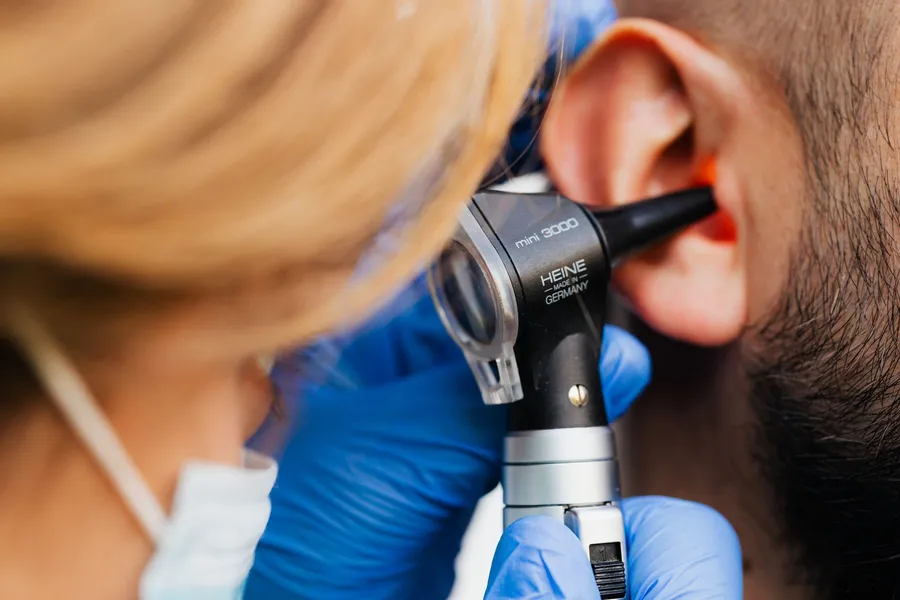
Medicare.gov’s page on hearing and balance exams says Part B “covers diagnostic hearing and balance (fall risk) exams if your doctor or other health care provider orders them to find out if you need medical treatment.” After the Part B deductible, you pay 20% of the Medicare-approved amount.
Then comes the line that saves people a doctor’s appointment:
“You can visit an audiologist once every 12 months without an order from your health care provider, but only for: Non-acute hearing conditions (like hearing loss that happens over many years); Diagnostic services related to hearing loss treated with surgically implanted hearing devices.”
Hearing that has faded gradually over years is exactly the “non-acute” case described. If that is you, you can book the audiologist directly once a year. What Medicare still will not pay for is the fitting exam — the visit whose purpose is to prescribe or adjust an aid. The diagnostic exam and the fitting exam are different appointments in Medicare’s eyes, and only the first one is covered.
Four Routes Compared
| Route | Who runs it | What you get | The main catch |
|---|---|---|---|
| Hearing Aid Project | Nonprofit — Sertoma International with Hearing Charities of America | Refurbished hearing aids at no cost, fitted through a partner audiologist | Currently limited to applicants near an existing audiology partner; needs an audiologist’s diagnosis and recommendation |
| Local Lions club | Nonprofit — volunteer clubs of Lions International | Varies entirely by club; some run hearing aid banks | No national application. You have to contact a club and ask |
| State AT Act program | Government-funded — one per state and territory, supported by the Administration for Community Living | Device loan, device demonstration, device reuse, and low-interest financing programs | Not hearing-specific; what is offered differs by state |
| VA | Government — Department of Veterans Affairs | Hearing aids, repairs and batteries at no charge | You must be enrolled in VA health care |
Two of these are nonprofit charity programs, not government benefits — nobody is entitled to them and nobody can appeal a “no.” The other two are public programs with published rules. Most people should pursue more than one at the same time.
Route 1: The Hearing Aid Project (Nonprofit)
The Hearing Aid Project was created by Sertoma International — a national service organization — and is run with Hearing Charities of America. Its own description: “providing hearing aids to low-income individuals on a national scale,” with donated aids refurbished and tracked in partnership with the Department of Hearing & Speech at the University of Kansas Medical Center. Partner audiologists do the evaluation, fitting and follow-up.
Its published qualifications are short:
- Hearing loss diagnosed and documented by a licensed audiologist
- A recommendation for hearing aid(s)
- Low income with no health insurance, or low income and insured but with a policy that provides zero coverage for hearing aids
- A resident of the United States
Two things on that page deserve more attention than they get:
It is not currently open everywhere. The page states: “The Hearing Aid Project continues to receive an overwhelming number of applications. To best serve you, we are currently accepting applications from individuals located within a reasonable distance of one of our existing audiology partners.” Articles that tell you to “just apply to the national program” are skipping this. Use the contact form to ask whether there is a partner near you before you build your hopes on it.
It tells you to look locally first. The page says: “Please explore your local resources before applying to the Hearing Aid Project,” and links its own resources directory — a state-by-state list covering all 50 states and DC, with Lions hearing aid banks, state commissions for the deaf and hard of hearing, university speech and hearing clinics, and state financing programs. In our reading, that directory is the most useful thing on the site, and it is the page nobody links to.
There is one explicit limit: “We cannot cover your deductible.” Contact is hap@sertoma.org or 816-895-2410.
Route 2: Your Local Lions Club (Nonprofit)
Lions International has collected and refurbished hearing aids for decades. Its eyeglasses and hearing aids recycling page confirms two facts that shape how you should approach it:
- Donated hearing aids go to Hearing Charities of America. The two nonprofit routes in this guide feed the same refurbishing pipeline.
- Assistance is granted locally, not nationally. “The best way for an individual to receive eyeglasses or hearing aids assistance from Lions International is to get in contact with a local Lions club or a district in your area.” Clubs are volunteer groups that “at times provide direct assistance to individuals.” There is no central form, no published income limit, and no promise.
Use the Club Locator on the same site, find a club near you, and click the envelope icon to message it. Expect to explain your situation in your own words. Some districts run a standing hearing aid bank; some do not.
Route 3: Your State’s Assistive Technology Act Program (Government-Funded)
This is the route seniors almost never hear about. Every state and territory has a program funded under the federal Assistive Technology Act, and the AT Act Programs directory kept by the AT3 Center — which is supported by the Administration for Community Living at HHS — lists one for all 50 states, the District of Columbia and the U.S. territories, 56 entries in all, most with a named contact for each of four services:
- Device loan — borrow a device before you commit to buying one
- Device demonstration — try different devices side by side
- Device reutilization — refurbished equipment passed on to someone who needs it
- Financial loan — low-interest financing programs for assistive technology, often called Alternate Financing Programs
None of this is hearing-specific, which is exactly why it goes unmentioned in hearing aid articles. But hearing aids and assistive listening devices are assistive technology, and a device loan program is the only route in this guide that lets you try before you buy. Look up your state in the directory and call the program director listed there.
Route 4: The VA (Government, for Enrolled Veterans)
The VA’s Prosthetic & Sensory Aids Service page on hearing aids sets out the sequence: register at the enrollment section of a VA Medical Center — in person, online with Form 10-10EZ, or by mail — then schedule an appointment at the Audiology and Speech Pathology Clinic.
“The audiologist will make a clinical determination on the need for hearing aids and/or other hearing assistive devices. If hearing aids are recommended and fit, the hearing aids, repairs, and future batteries will all be at no charge to you, as long as you maintain VA eligibility for care.”
Registration usually asks for a copy of the veteran’s DD214, a driver’s license, and health insurance information if you have it. Batteries can be reordered by mail on VA Form 2346 or by phone through the Denver Acquisition & Logistics Center at 303-273-6200. The nonprofit Hearing Aid Project tells veterans on its own page to check VA benefits before applying to it — that is the order to work in.
Before You Apply: The Checklist

Gather these before you contact anyone. Every route above asks for some subset of them, and having them ready is the difference between one phone call and five.
- An audiogram from a licensed audiologist, dated. This is the single non-negotiable document. Book the Medicare-covered diagnostic exam described above if you do not have one.
- A written recommendation for hearing aids from that audiologist — not just the test results.
- Proof of income. Social Security award letter, recent tax return, or pension statements. Charity programs say “low income” without publishing a number, so let them apply their own test.
- Your insurance card and, if you have one, the page of your policy that shows hearing aids are not covered. The Hearing Aid Project’s second eligibility path is specifically for people who are insured with zero hearing aid coverage — proving that is what puts you in it.
- Your Medicare or Medicaid number, and a note of whether you are on Medicaid at all.
- DD214, if you are a veteran.
- Your ZIP code and a willingness to travel. The Hearing Aid Project’s availability turns on distance to a partner audiologist; a Lions club two towns over may have a program yours does not.
- A written list of what you cannot hear. “I can’t follow my grandchildren at the dinner table” is the kind of concrete detail a volunteer committee acts on.
Two Names You Will See Everywhere
Search for hearing aid charities and you will meet two brand names within seconds. Here is what we could and could not verify on their own sites today.
Starkey. The Starkey Cares page describes a Hear Now Program that offers the company’s hearing technology “at a significantly reduced cost,” with a phone number and email to be referred to a partner. The same page carries a correction worth knowing, in Starkey’s own words: “Please note: Starkey Cares is not affiliated with the Starkey Hearing Foundation, which operates as a separate nonprofit focused on education and training for hearing health professionals in developing countries.” Many roundups still describe “Hear Now” as a program of the Starkey Hearing Foundation. The company’s own page says otherwise. Unverified: we could not open a page today publishing Hear Now’s income thresholds or any application fee, so we are not repeating figures we have seen quoted elsewhere. Ask directly before you send money or paperwork.
Miracle-Ear Foundation. Its Gift of Sound program describes hearing aids and support services “at no cost” to people who meet eligibility requirements and “who are unable to use other available resources,” with a three-year warranty and lifetime aftercare. Unverified: the eligibility and application page linked from that description did not open for us today, so we cannot state its income rules or documentation requirements.
Both are affiliated with hearing aid manufacturers or retailers rather than being independent charities. That does not make them bad options — it makes it worth asking, up front, exactly what is free, what is discounted, and what is a sale.
What About Over-the-Counter Hearing Aids?
Since the FDA’s rule took effect, you can buy an OTC hearing aid off a shelf with no professional involved. 21 CFR 800.30 defines the category narrowly, and the definition is your buying guide:
- It is “intended for use by a person age 18 or older to compensate for perceived mild to moderate hearing impairment.”
- Output is capped at 111 dB SPL at any frequency — 117 dB SPL if input-controlled compression is switched on.
- The rule’s own closing line on scope: air-conduction hearing aids that do not satisfy those requirements “are prescription hearing aids.” The line between the two categories is drawn by regulation, not by marketing.
NIDCD’s plain-language version: prescription aids “may be necessary for more significant or complicated hearing loss.” So if an audiologist has told you your loss is severe or profound, an OTC device is not a cheaper version of what you were prescribed — it is a different, legally weaker device. If your loss is mild to moderate and money is the obstacle, OTC is a legitimate route and it needs no application at all.
If None of These Work
- Start with a screening of everything at once. BenefitsCheckUp from NCOA checks dozens of programs for people 60 and older in one pass.
- Lower the other medical bills instead. Medicare Savings Programs can pay your Part B premium and Extra Help cuts drug costs; our comparison of the two explains which does what. Freeing up a premium payment is not a hearing aid, but it is the same money.
- The hearing exam itself is the cost you cannot cover. A community health center charges on a sliding scale based on income.
- You are already facing a hospital bill. Charity care rules may wipe out or reduce it, which changes what you can spend elsewhere.
- You do not know where to start. Dial 2-1-1 — our 211 guide explains what that call can and cannot do.
- The other senior health programs. Free dental care through Donated Dental Services and no-cost eye exams through EyeCare America are the two closest cousins to this guide, and both are nonprofit programs with published rules.
How We Checked This
Every rule in this guide was read in a primary source, not in another site’s summary.
The Medicare position comes from the regulation and from Medicare’s own consumer page: 42 CFR 411.15 for the text of the exclusion and its exceptions, and Medicare.gov’s hearing and balance exams page for what Part B pays and the once-every-12-months direct audiologist visit. The (d)(2) exception is the reason this guide exists in this shape — the widely repeated line “Medicare does not cover hearing devices” is contradicted by the regulation’s own subparagraph naming osseointegrated implants and cochlear implants, and NIH’s NIDCD page confirms it in consumer language.
The OTC limits are from the FDA regulation itself, 21 CFR 800.30, including the numeric output ceilings, which do not appear on the consumer pages that recommend OTC aids to seniors.
The nonprofit details come from the organizations’ own pages, opened on August 26, 2026: the Hearing Aid Project’s Get an Aid, About and Resources pages, and Lions International’s eyeglasses and hearing aids recycling page. The geographic restriction on Hearing Aid Project applications, and its instruction to try local resources first, are quoted from that page and are the single most important thing on it. The VA sequence is from the VA Prosthetic & Sensory Aids Service page, and the state program counts are from the AT3 Center directory.
What we did not verify, and therefore did not print: a national average price for hearing aids; income thresholds or application fees for Starkey’s Hear Now program; eligibility rules for the Miracle-Ear Foundation’s Gift of Sound program; and any state-by-state table of adult Medicaid hearing aid coverage. Pages for the first three either did not open or did not publish the figures on August 26, 2026, and we would have had to copy numbers from secondary sites to fill the gaps.
If a program tells you something different from what you read here, trust the program for your own case — charities set and change their own rules — and tell us so we can re-check the guide.
Last updated: August 26, 2026. The Hearing Aid Project and Lions International programs are nonprofit charity programs, not government benefits: they are not entitlements, availability depends on donated equipment and local volunteers, and neither guarantees help to anyone who qualifies. Medicare figures are the 2026 federal rules; state Assistive Technology Act services, Medicaid adult hearing aid coverage and local Lions programs vary by state and change. This is general information, not legal or financial advice.
Frequently Asked Questions
Does Medicare pay for hearing aids in 2026?
Original Medicare does not. Medicare.gov says plainly: "Original Medicare doesn't cover hearing aids or exams for fitting hearing aids." The exclusion is written into the regulation at 42 CFR 411.15(d), and it covers both air-conduction and bone-conduction hearing aids. But the same regulation carves out two implanted device categories by name — osseointegrated implants in the skull bone, and cochlear and auditory brainstem implants — and says the hearing aid exclusion "shall not apply" to them. NIH's NIDCD puts it in plain words: Medicare treats a bone-anchored hearing aid as a prosthetic device, not a hearing aid, and will cover it if the other coverage rules are met.
Will Medicare pay for the hearing test I need to apply for a charity hearing aid?
Usually yes, and this is the part most people miss. Medicare Part B covers diagnostic hearing and balance exams when a doctor or other provider orders them to find out whether you need medical treatment; you pay 20% of the Medicare-approved amount after the Part B deductible. Medicare.gov also says you can see an audiologist once every 12 months without any order for non-acute hearing conditions — the kind of hearing loss that comes on gradually over years. Every charity hearing aid application we read requires hearing loss "diagnosed and documented by a licensed audiologist," so this visit is the first step, not a separate errand.
Who gives away free hearing aids to seniors?
The largest national nonprofit route is the Hearing Aid Project, created by Sertoma International and run with Hearing Charities of America. It places refurbished hearing aids with low-income people through partner audiologists at no cost to the recipient. It is a charity program, not a government benefit. One honest caveat straight from its own page: because of application volume, it is currently accepting applications only from people "located within a reasonable distance of one of our existing audiology partners," and it asks you to explore local resources first. Local Lions clubs are the other well-known nonprofit route, and Lions International says the way to get help is to contact a club near you, not headquarters.
I am a veteran. Do I get hearing aids free?
If you are enrolled in VA health care, the VA's Prosthetic & Sensory Aids Service says that once an audiologist determines you need them, "the hearing aids, repairs, and future batteries will all be at no charge to you, as long as you maintain VA eligibility for care." You register at a VA Medical Center — in person, online with Form 10-10EZ, or by mail — and then schedule an audiology appointment. The nonprofit Hearing Aid Project tells veterans to check VA benefits before applying to it.
Are over-the-counter hearing aids a real substitute?
For some people, and the FDA rule is specific about which people. Under 21 CFR 800.30, an OTC hearing aid is for a person 18 or older "to compensate for perceived mild to moderate hearing impairment," and the regulation caps its output at 111 dB SPL (117 dB SPL with input-controlled compression activated). An air-conduction aid that does not meet those limits is, by definition in the same rule, a prescription hearing aid. NIDCD says prescription aids "may be necessary for more significant or complicated hearing loss." So OTC is a genuine option for mild to moderate loss, and by regulation it is not built for severe loss.
Does Medicaid cover hearing aids for adults?
It depends on your state, and you have to ask. NIDCD is definite about one group only: for eligible children and young adults 21 and under, Medicaid pays for diagnosis and treatment of hearing loss, including hearing aids, under the EPSDT benefit. For adults, hearing aid coverage is a state decision, and we are not printing a state-by-state table here because we could not verify one from a primary source. Call your state Medicaid office and ask specifically about hearing aids for adults — the answer is different in different states and it changes.
Sources
- 42 CFR 411.15 — Particular services excluded from coverage. Paragraph (d) excludes "Hearing aids or examinations for the purpose of prescribing, fitting, or changing hearing aids," and (d)(1) says the exclusion "encompasses all types of air conduction hearing aids… and bone conduction hearing aids." Paragraph (d)(2), "Devices not subject to the hearing aid exclusion," says the exclusion "shall not apply to the following devices that produce the perception of sound by replacing the function of the middle ear, cochlea, or auditory nerve: (i) Osseointegrated implants in the skull bone… or (ii) Cochlear implants and auditory brainstem implants."
- Medicare.gov — Hearing & balance exams ("Part B covers diagnostic hearing and balance (fall risk) exams if your doctor or other health care provider orders them to find out if you need medical treatment."; "Original Medicare doesn't cover hearing aids or exams for fitting hearing aids."; "After you meet the Part B deductible, you pay 20% of the Medicare-approved amount."; "You can visit an audiologist once every 12 months without an order from your health care provider, but only for: Non-acute hearing conditions (like hearing loss that happens over many years); Diagnostic services related to hearing loss treated with surgically implanted hearing devices")
- NIDCD (NIH) — Hearing Aids ("Medicare does not cover hearing aids for adults; however, diagnostic evaluations are covered if they are ordered by a physician for the purpose of assisting the physician in developing a treatment plan. Since Medicare has declared the BAHA a prosthetic device and not a hearing aid, Medicare will cover the BAHA if other coverage policies are met."; "For eligible children and young adults ages 21 and under, Medicaid will pay for the diagnosis and treatment of hearing loss, including hearing aids, under the Early and Periodic Screening, Diagnostic, and Treatment (EPSDT) service."; "Some nonprofit organizations provide financial assistance for hearing aids, while others may help provide used or refurbished aids."; OTC hearing aids "are intended to help adults with perceived mild to moderate hearing loss… Prescription hearing aids or other devices may be necessary for more significant or complicated hearing loss.")
- 21 CFR 800.30 — Over-the-counter hearing aid controls (an OTC hearing aid "is intended for use by a person age 18 or older to compensate for perceived mild to moderate hearing impairment"; "An OTC hearing aid shall not exceed an output limit of 111 dB SPL at any frequency" except that a device "that has input-controlled compression activated shall not exceed an output limit of 117 dB SPL"; air-conduction hearing aids that do not satisfy the section's requirements "are prescription hearing aids")
- Hearing Aid Project (Hearing Charities of America / Sertoma International) — Get an Aid ("The Hearing Aid Project continues to receive an overwhelming number of applications. To best serve you, we are currently accepting applications from individuals located within a reasonable distance of one of our existing audiology partners."; qualifications: "Hearing loss diagnosed and documented by a licensed audiologist", "Recommendation for hearing aid(s)", "Low income- no health insurance", "Low income- insured, but your policy provides zero coverage for hearing aids", "A resident of the United States"; "Please note: We cannot cover your deductible"; "Please explore your local resources before applying"; audiology partners are recruited to help "low-income individuals receive no-cost hearing aids in your community"; contact hap@sertoma.org, 816-895-2410)
- Hearing Aid Project — About ("The Hearing Aid Project (HAP) is a unique model and one-of-a-kind collaboration created by Sertoma International… by providing hearing aids to low-income individuals on a national scale."; HAP "has partnered with the Department of Hearing & Speech at the University of Kansas Medical Center to maintain and track all of the hearing aids in the program")
- Hearing Aid Project — Resources directory (national organizations plus a state-by-state list for all 50 states and DC, including Lions hearing aid banks, state commissions for the deaf and hard of hearing, Assistive Technology Act programs and Alternate Financing Programs)
- Lions Clubs International — Eyeglasses and hearing aids recycling ("Those interested in donating used hearing aids of any age, brand or model can do so by visiting the Hearing Charities of America donations page."; "The best way for an individual to receive eyeglasses or hearing aids assistance from Lions International is to get in contact with a local Lions club or a district in your area."; "Please use the Club Locator to find a local club near your community.")
- U.S. Department of Veterans Affairs, Prosthetic & Sensory Aids Service — Hearing Aids ("To receive hearing aids through VA, you must first register at the health Administration/enrollment section of the VA Medical Center of your choice."; "The audiologist will make a clinical determination on the need for hearing aids and/or other hearing assistive devices. If hearing aids are recommended and fit, the hearing aids, repairs, and future batteries will all be at no charge to you, as long as you maintain VA eligibility for care.")
- AT3 Center — AT Act Programs directory (a state Assistive Technology Act program listed for all 50 states, the District of Columbia and the U.S. territories — 56 entries — most with named contacts for Device Loan, Device Demo, Device Reutilization and Financial Loan. The AT3 Center "is supported by the Administration for Community Living (ACL), U.S. Department of Health and Human Services (HHS)")
- Starkey — Starkey Cares ("Please note: Starkey Cares is not affiliated with the Starkey Hearing Foundation, which operates as a separate nonprofit focused on education and training for hearing health professionals in developing countries."; the company describes offering "our most advanced hearing technology at a significantly reduced cost" through the Starkey Cares Hear Now Program)
Keep reading
- Low-Cost Clinics Near You: Community Health Centers 2026 Medical and dental care on a sliding scale — with or without insurance Read guide →
- Free Medicare Help for Open Enrollment 2026: SHIP Checklist SHIP counselors are not paid per enrollment — and Medicare Open Enrollment runs October 15 to December 7, 2026 Read guide →
- Medicare Savings Program vs Extra Help: Can You Get Both? Filing one application can start the other — but only in one direction Read guide →
This is general information, not legal or financial advice.