Free Monthly Food Box for Seniors 60+: CSFP Limits 2026
Last updated:
Apply on the official site →If you are 60 or older and money runs out before the month does, there is a federal program that hands you a box of groceries every month. It is called the Commodity Supplemental Food Program (CSFP), and most people who qualify have never heard the name.
It is not a card, not a reimbursement, and not a loan. USDA buys the food, ships it to a local agency near you, and you pick it up — or in some states, it is delivered.

The part worth reading carefully is the income test, because the number that circulates most widely is the wrong one.
Who Qualifies
The federal rule has exactly two tests. 7 CFR 247.9 puts it plainly: “To be eligible for CSFP, individuals must be at least 60 years of age and meet the income eligibility requirements.”
- You are at least 60. Not 62, not 65. Sixty.
- Your household income is within your state’s CSFP limit, which federal rules cap at 150% of the HHS poverty guidelines.
Those are the only two tests the federal rule imposes on everyone. There is no work requirement, no asset test in the federal rule, and no requirement that you be a U.S. citizen’s dependent or a veteran or anything else.
Two things your state is allowed to add, and you should ask about: the same regulation, at 247.9(e), says a state agency “may require that an individual be at nutritional risk, as determined by a physician or by local agency staff,” and “may require that an individual reside within the service area of the local agency at the time of application.” The residency option is limited — the rule says the state “may not require that an individual reside within the area for any fixed period of time,” so a recent move cannot be held against you.
The Income Numbers for 2026
The regulation says the state “must use a household income limit at or below 150 percent” of the poverty guidelines that HHS publishes each January. The 2026 guidelines were published on January 15, 2026. Here is what 150% of them works out to:
| Household size | 2026 poverty guideline | 150% (per year) | 150% (per month) |
|---|---|---|---|
| 1 person | $15,960 | $23,940 | about $1,995 |
| 2 people | $21,640 | $32,460 | about $2,705 |
| 3 people | $27,320 | $40,980 | about $3,415 |
| 4 people | $33,000 | $49,500 | about $4,125 |
| Each additional person | +$5,680 | +$8,520 | about +$710 |
You do not have to take our arithmetic on faith. New York’s Department of Health publishes the CSFP table itself, and its income eligibility page — revised February 2026 — prints exactly these figures for a program that “must be at or below 150% Federal Poverty Guidelines,” noting the amounts are gross income: $23,940 a year and $1,995 a month for one person, rising to $83,580 and $6,965 for eight, and “For each additional household member add: $8,520 … $710.”
Those figures are for the 48 contiguous states and the District of Columbia. Alaska and Hawaii are higher — the 2026 one-person guideline is $19,950 in Alaska and $18,360 in Hawaii, so 150% is $29,925 and $27,540.
Three qualifiers that matter:
- 150% is a ceiling, not a promise. The rule says “at or below,” so a state may set its limit lower. Your state publishes its own table each year after USDA sends the updated figures — and the update may not land in January. 7 CFR 247.9(c) says FNS notifies state agencies “by memorandum, of adjusted income guidelines,” and “the State agency must implement the adjusted guidelines immediately upon receipt of the memorandum.” That is why New York’s table above carries a February 2026 revision date rather than a January one. If your state’s posted table still shows last year’s numbers, the memo may simply not have reached it yet — ask.
- Income means gross income — the amount before taxes and deductions come out, not your take-home.
- These are annual figures. The monthly column above is the yearly number divided by twelve, which is how most people think about a fixed income, but your agency may apply the test on a different period.
Where the “185%” Number Comes From
If someone has told you the senior food box cuts off at 185% of poverty, that number is real — it just belongs to a different program.
USDA runs two food programs for people 60 and older, and they have different income limits:
| Program | What you get | Income limit |
|---|---|---|
| CSFP (this guide) | A monthly package of USDA foods | 150% of poverty (7 CFR 247.9) |
| SFMNP (Senior Farmers Market Nutrition Program) | Coupons for fresh produce, honey, and herbs at farmers markets | 185% of poverty (7 CFR 249.6) |
Plain-language government pages sometimes describe both programs in a single paragraph and list one income figure underneath. USA.gov’s page for older adults does this — it introduces SFMNP and CSFP together, then gives 185% as the shared test.
Why this matters to you: the two limits point in opposite directions depending on which mistake was made. If you were quoted 185% and turned away, and your income is between the two lines, the 150% figure may be why. If you were quoted 150% for the farmers market coupons, you may qualify for those even though the food box is out of reach. Do not rule yourself out of either program based on a number you read. Ask the agency which program it is and what its current table says.
The Rule That Beats the Income Test
This is the part almost nobody knows, and it is the reason to apply even if you did the math above and came out over the line.
The same regulation lets your state agency accept you as income-eligible if you are already certified as fully eligible for any of these:
- SNAP (food stamps)
- The Food Distribution Program on Indian Reservations
- Supplemental Security Income (SSI)
- The Low Income Subsidy program — better known as Extra Help with Medicare drug costs
- A Medicare Savings Program
And then the rule says something unusually direct: applicants who are eligible this way “shall not be subject to the income limits.” Not a higher limit — no income limit.
One honest caveat: the regulation says the state agency may accept this proof, not that it must. So it is a state option rather than a nationwide guarantee. But it costs you nothing to bring your SSI award letter, your Extra Help notice, or your SNAP approval to the appointment and ask. If you are on any of those five programs, that piece of paper is the strongest thing you can walk in with.
What You Actually Receive
Federal rules require the local agency to give you “a package of USDA Foods… each month, or a two-month supply… every other month.” USA.gov describes it as “a monthly package of healthy food,” picked up at a local agency, with delivery available in some states.
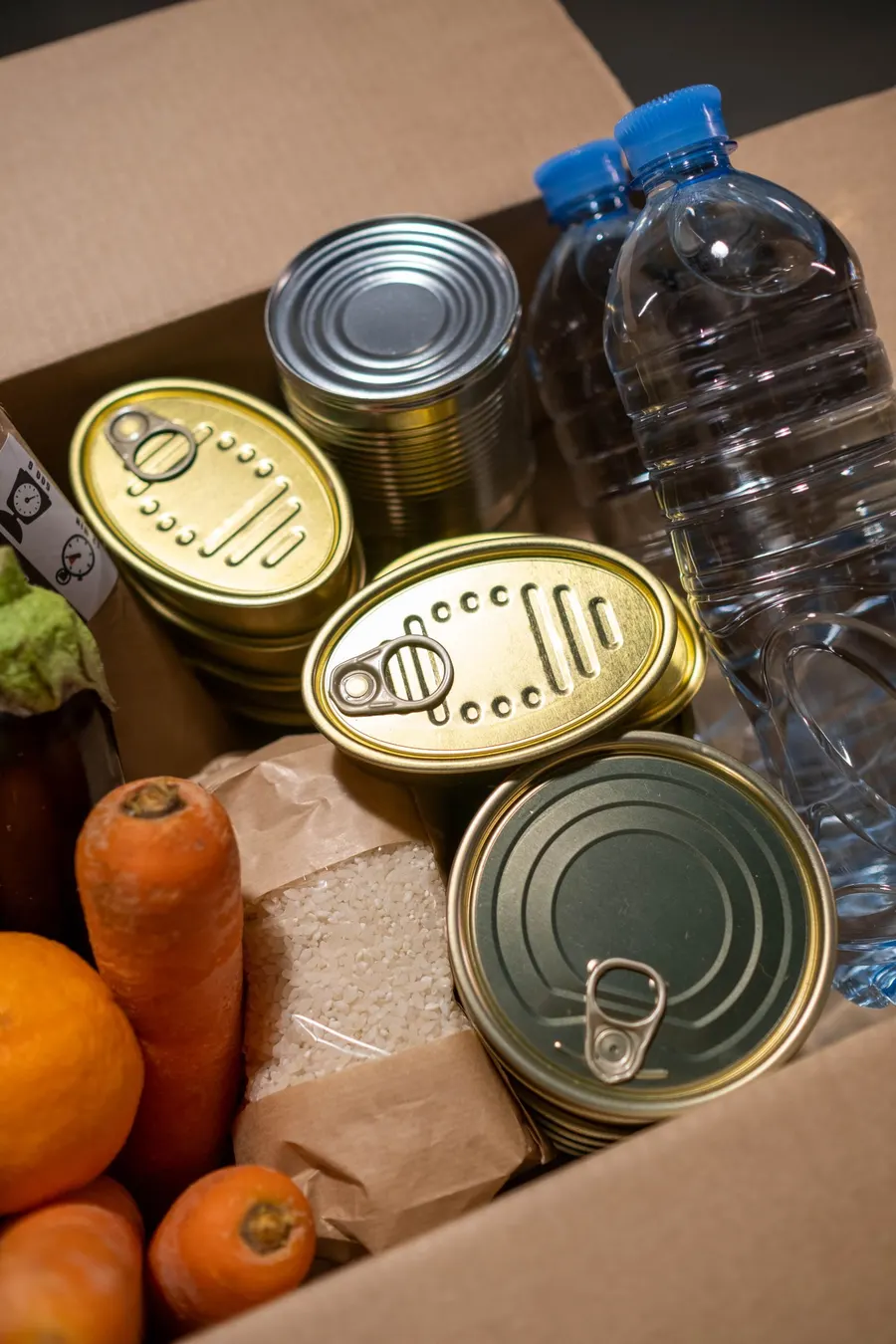
We are deliberately not printing a food list here. The specific contents come from USDA’s food package guide rates, which change, and what reaches your site depends on what your state ordered and received. Ask your local agency what is in the current month’s box.
It is free. The regulation is emphatic: state and local agencies “must not require, or request, that participants make any payments, or provide any materials or services, in connection with the receipt of USDA Foods.” No fee, no donation, no volunteer hours in exchange.
How to Apply — Four Steps
- Find out whether your state runs CSFP. It is not in every state. USA.gov directs people to USDA’s FNS contacts directory to find and contact your state CSFP program. If your state is not listed, skip to the alternatives at the bottom of this page.
- Call the state agency and ask for the local agency nearest you. CSFP is handed off to local agencies — often a food bank, a community action agency, or a county office — and that local agency is the one that certifies you and hands you the box.
- Bring the four things the application asks for. 7 CFR 247.8 requires your name and address with some form of identification, your household income, your household size, and information such as your age. Bring proof of the other programs you are on, per the section above.
- If you are told the slots are full, ask to be put on the waiting list in writing. This is a real, regulated step — not a brush-off. Read the next section before you leave.
About the Waiting List
Each local agency is funded to serve a set number of people, called its caseload. When those slots are full, the agency does not simply turn you away — 7 CFR 247.11 requires it to “maintain a waiting list of individuals who apply for the program,” recording the date of your application and how to reach you.
Two things follow from that:
- You must be told within 10 days that you have been placed on the list, unless you were found ineligible.
- The date on your application matters. Agencies commonly work the list “on a first-come, first-served basis,” so applying during a full period is not wasted effort — it is how you get your place in line.
Once you are certified, the certification period runs between one and three years depending on your state, so this is not a form you refile every month.
If CSFP Is Not Available Where You Are
- Your state does not run CSFP. SNAP is in every state and has its own rules for households with someone 60 or older. USA.gov points people to SNAP for exactly this situation.
- You want fresh produce instead. The Senior Farmers Market Nutrition Program uses the more generous 185% limit — $29,526 a year for one person in 2026 — and pays out $20 to $50 a year in farmers market coupons. Ask your state’s aging or agriculture department whether it participates.
- You need food this week. A food bank does not require certification. Our guide to finding a Feeding America food bank covers how to locate one today.
- Leaving the house is the hard part. Meals on Wheels delivers prepared meals to older adults at home, which is a different service from a grocery box.
- The pressure is really the medical bills. Medicare Savings Programs and Extra Help lower premiums and drug costs — and, as above, either one may be your ticket past the CSFP income test.
If you are not sure where to start, dial 2-1-1. Our 211 guide explains what that call can and cannot do.
How We Checked This
Every figure in this guide was read directly from a primary source, not from another website’s summary: the eligibility tests and payment prohibition from the federal CSFP regulation (7 CFR part 247), the income line from the 2026 HHS poverty guidelines as published by HHS, and the program description from USA.gov. Where a widely repeated number conflicts with the regulation — the “185%” figure that actually belongs to a different program — we say so above and cite where each number really comes from. If you find something here that contradicts what your local agency tells you, trust the agency for your case and tell us so we can re-check the guide.
Re-checked on September 12, 2026. Three things changed, and one did not:
- We added a second, independent source for the income table. Until now the 150% figures here were our own arithmetic on the HHS guidelines. We found a state agency that publishes the CSFP table directly — the New York State Department of Health’s CSFP income eligibility page, revised February 2026 — and every figure matches to the dollar. That page is now cited above so you can check the numbers against a government source rather than against our math.
- We corrected an overstatement about the eligibility test. The previous version said age and income were “the whole eligibility test.” They are the only two tests imposed on every state, but 247.9(e) also lets a state require a nutritional-risk determination or residence in the local agency’s service area. We now say so, along with the limit on the residency option.
- We fixed six source links. The eCFR moved 7 CFR parts 247 and 249 from subchapter B to subchapter A; the old addresses now redirect. Every citation on this page points at the current address.
- The numbers themselves did not move. The regulation’s text and the 2026 poverty guidelines are unchanged since our last check, so the income limits above are the same figures as before.
One thing we could not read: USDA’s own Food and Nutrition Service pages, including the FNS contacts directory we link to below and USDA’s own published CSFP income-guidelines sheet, block automated retrieval and returned an error to us. Those links are for you to open in a browser; we verified the figures on them through the New York State table and the regulation instead, and we do not print anything sourced only from a page we could not read.
CSFP is a federal program administered by state and local agencies; income limits, participating states, waiting times, and food package contents vary by state and change from year to year, and the figures above are the 2026 federal guidelines rather than your state’s published table. The federal regulations, the 2026 HHS poverty guidelines, the New York State CSFP table, and the USA.gov page were verified on September 12, 2026.
Frequently Asked Questions
What is the income limit for the senior food box program in 2026?
Federal rules say the state must use a household income limit at or below 150% of the HHS poverty guidelines. Using the 2026 guidelines, 150% is $23,940 a year — about $1,995 a month — for a one-person household in the 48 contiguous states and DC, and $32,460 a year, about $2,705 a month, for two people. Alaska and Hawaii are higher. Your state publishes its own table each year, and it can be lower than 150%, so ask your local agency for the current figure rather than relying on a number you read anywhere, including here.
Is the CSFP income limit 150% or 185% of poverty?
For CSFP it is 150%. The 185% figure is real, but it belongs to a different USDA program for seniors — the Senior Farmers Market Nutrition Program, where 7 CFR 249.6 sets the limit at 185%. Some plain-language government pages describe both programs in one paragraph and attach 185% to both. If you were told you were over the limit at 185%, that number may have come from the wrong program, and it is worth asking again.
Can I get CSFP if my income is over the limit?
Possibly. Federal rules let a state agency treat you as income-eligible if you are already certified as fully eligible for SNAP, the Food Distribution Program on Indian Reservations, SSI, the Low Income Subsidy program (Extra Help for Medicare drug costs), or a Medicare Savings Program. If your state uses that option, the regulation says you are not subject to the income limit at all. This is a state choice, not an automatic nationwide rule, so bring proof of the other program and ask.
Does CSFP cost anything?
No. Federal rules say state and local agencies "must not require, or request, that participants make any payments, or provide any materials or services, in connection with the receipt of USDA Foods." There is no application fee and no charge for the food. Anyone who asks you to pay to sign up, or to pay to be moved up a waiting list, is not running the program.
How long does it take to get the food box?
It depends on whether your local agency has an open slot. Each agency is funded for a set number of participants, and when those slots are full it must keep a waiting list and tell you within 10 days that you are on it. Agencies commonly work the list in the order applications came in. Once you are certified, the certification lasts between one and three years depending on your state, so you do not reapply every month.
Do I still have to be a woman, infant, or child to qualify?
No. CSFP used to serve those groups as well, but the current federal rule is straightforward: you must be at least 60 years old and meet the income rules. Age and income are the tests today.
Sources
- 7 CFR 247.9 — CSFP eligibility requirements ("To be eligible for CSFP, individuals must be at least 60 years of age and meet the income eligibility requirements outlined in paragraph (b) of this section."; "The State agency must use a household income limit at or below 150 percent of the U.S. Federal Poverty Guidelines published annually by the U.S. Department of Health and Human Services (HHS)."; the State agency "may accept as income-eligible for CSFP benefits any applicant that documents that they are certified as fully eligible for the following Federal programs: the Supplemental Nutrition Assistance Program, the Food Distribution Program on Indian Reservations, Supplemental Security Income (SSI), the Low Income Subsidy Program, or the Medicare Savings Programs."; "Applicants who are adjunctively income eligible… shall not be subject to the income limits established under paragraph (b) of this section."; "Income means gross income before deductions")
- 7 CFR 247.10 — Distribution and use of USDA Foods ("The local agency must distribute a package of USDA Foods to participants each month, or a two-month supply of USDA Foods to participants every other month, in accordance with the food package guide rates established by FNS."; "State and local agencies must not require, or request, that participants make any payments, or provide any materials or services, in connection with the receipt of USDA Foods.")
- 7 CFR 247.11 — Applicants exceed caseload levels ("If all caseload has been filled, the local agency must maintain a waiting list of individuals who apply for the program."; "applicants must be notified of their placement on a waiting list within 10 days of their request for benefits"; "a local agency may certify eligible individuals from the waiting list based on the date the application was received on a first-come, first-served basis")
- 7 CFR 247.8 — Individuals applying to participate in CSFP (application must provide "Name and address, including some form of identification for each applicant", "Household income", "Household size", and "Other information related to eligibility, such as age")
- 7 CFR 247.16 — Certification period ("The State agency must establish certification periods that are not less than one year but not more than three years in duration.")
- 7 CFR 249.6 — SFMNP eligibility ("Participants must have a maximum household income of not more than 185 percent of the annual poverty income guidelines") — the source of the 185% figure that is often misapplied to CSFP
- New York State Department of Health — CSFP Income Eligibility Guidelines, revised February 2026 (a state agency's published CSFP table at 150% of the 2026 poverty guidelines: 1 person $23,940/year and $1,995/month; 2 people $32,460 and $2,705; 3 people $40,980 and $3,415; 4 people $49,500 and $4,125; "For each additional household member add: $8,520 … $710"; "Household income must be at or below 150% Federal Poverty Guidelines"; "Figures below are gross Income")
- HHS — Annual Update of the HHS Poverty Guidelines, published January 15, 2026 (2026 guideline for the 48 contiguous states and DC: $15,960 for 1 person, $21,640 for 2, $27,320 for 3, $33,000 for 4, add $5,680 per additional person; Alaska $19,950 for 1; Hawaii $18,360 for 1)
- USA.gov — Food assistance programs for older adults ("Commodity Supplemental Food Program (CSFP) - Provides a monthly package of healthy food. USDA distributes food to local agencies where you can pick it up. In some states, you may be eligible to have your food delivered."; "SFMNP and CSFP are not available in every state."; last updated December 23, 2025)
Keep reading
- Find a Food Bank Near You: Feeding America Guide (2026) Free groceries through 250+ food banks and 60,000+ local pantries Read guide →
- Period Supplies Near You 2026: Where to Get Pads & Tampons SNAP and WIC cannot buy pads or tampons — local nonprofit programs give period supplies to people who need them Read guide →
- Diaper Bank Near You 2026: Get Diapers & Who Qualifies SNAP and WIC cannot buy diapers — diaper banks give them out at no cost Read guide →
This is general information, not legal or financial advice.