Find a Food Bank Near You: Feeding America Guide (2026)
Last updated:
Apply on the official site →If groceries don’t fit the budget this week, a food pantry near you can help — today, and at no cost. This guide shows how to find your nearest food bank through Feeding America, who can get food, and what to expect on a first visit.

Note: Feeding America is a nonprofit organization and its food banks are charities — this is not a government program. It works alongside government programs like SNAP and WIC, which we link below.
What Is Feeding America?
Feeding America is a nationwide nonprofit hunger-relief network. According to feedingamerica.org, the network includes:
- 250+ food banks across all 50 states and Puerto Rico
- 60,000+ agency partners, food pantries, and meal programs
- 5.9 billion meals provided each year
Food banks collect food from farmers, manufacturers, retailers, and government agencies, then supply the local pantries and meal programs where people actually receive food.
How to Find a Food Bank or Pantry Near You
- Go to the official finder. Open Feeding America’s Find Your Local Food Bank page.
- Enter your ZIP code (or search by state). The tool shows your nearest Feeding America food bank.
- Check hours, locations, and services at partner food pantries and meal programs listed for your area — many food banks list local distributions on their own sites.
- Prefer the phone? Feeding America points to Hunger Free America’s Hunger Hotline: 1-866-348-6479 (English) or 1-877-842-6273 (Spanish), Monday–Friday, 8 a.m.–8 p.m. ET, per feedingamerica.org.
- You can also dial 211 — see our 211 guide to getting help with bills and food.
Who Can Get Food?
According to Feeding America, “anyone who needs extra help affording food can visit a food pantry or meal program” — including working families. Your local food bank “can help you find food today, even if you need temporary help,” Feeding America says.
Two things to know:
- The food is free. Feeding America states plainly: “A food pantry is where people can get free food.”
- Some pantries have their own rules. Feeding America says some pantries or programs “may have additional requirements, like living in a certain area,” so check your local pantry’s listing before visiting.
- Many food banks also help with baby supplies. “Many food banks help with free baby food, formula, and diapers,” Feeding America says, and “they can also connect you to your local diaper bank.” See our diaper bank guide, and for pads and tampons, our period supplies guide.
What to Expect on Your First Visit
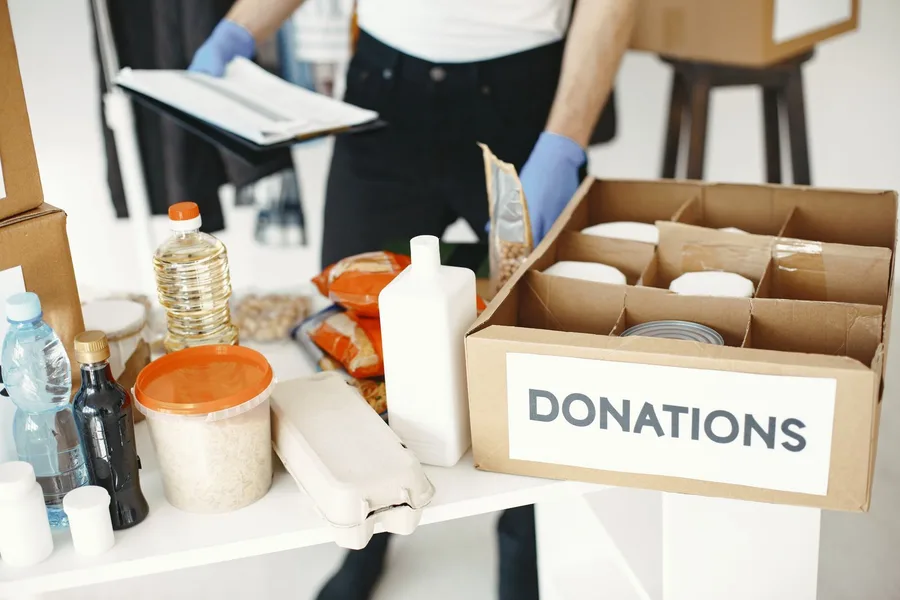
On a first visit, staff may ask questions or have you fill out a form about your family’s needs — this helps them give you the right amount of food and connect you with other programs, according to feedingamerica.org. Friendly volunteers are there to help.
The network includes more than classic pantries, per feedingamerica.org: food pantries, soup kitchens, mobile food pantries, drive-thru pantries, school pantry programs, and senior programs — so search your area even if you can’t visit a fixed location during work hours.
Food Banks and Government Programs Work Together
A food pantry solves this week’s groceries; government programs can help every month:
- SNAP (food stamps): Feeding America notes SNAP “currently provides 1 in 7 Americans with help making ends meet.” See our SNAP income limits and application guide — a family of 4 can get up to $994/month in FY 2026.
- WIC: provides “healthy, supplemental food to low-income people who are pregnant and have children,” per feedingamerica.org — apply through your state WIC agency. Federal WIC rules and age limits are in our WIC guide.
- Money freed up elsewhere helps the food budget too: see our LIHEAP energy bill guide and the Lifeline phone and internet discount.
How We Checked This
Feeding America is a charity, not a government agency, so there is no regulation to check this guide against — the only authoritative source is the organization itself. On August 23, 2026 we re-opened all three of its own pages and compared them line by line with what we had published: About Us for the network size, Find Your Local Food Bank for who may visit and what happens on a first visit, and Need Help? Find Food for the hotline numbers and program types. Nothing had changed: still 250+ food banks, 60,000+ partner pantries and meal programs, 5.9 billion meals a year, and the same Hunger Hotline numbers and Monday–Friday 8 a.m.–8 p.m. ET hours.
Two things worth naming because they are widely misunderstood:
- A food bank is not a place you visit. The word people search for is “food bank near me,” but food banks are regional warehouses. The place you actually pick up groceries is a food pantry or meal program supplied by that food bank — which is why the ZIP search returns a food bank first and its partner sites second.
- Nobody in this network charges you for food, or for access to it. Feeding America’s own wording is that a food pantry is where people can get free food. Some pantries do set their own rules — most often serving a specific area — but a fee is not one of them. If a site asks you to pay to “register” for free groceries, it is not operating the way the network describes.
Re-checked on September 15, 2026. We re-opened all three pages. The network numbers (250+ food banks, 60k+ partners, 5.9B meals a year), the Hunger Hotline numbers and hours, “1 in 7” for SNAP, and “A food pantry is where people can get free food” are unchanged. We corrected three things:
- “No strings attached.” We had attached this phrase to everyone who needs temporary help. On Feeding America’s page it describes its senior food programs (“free groceries to older adults, with no strings attached”). What the page says for everyone is that your food bank “can help you find food today, even if you need temporary help.” We now quote that instead.
- “A short form.” The page says volunteers “may ask questions or have you fill out a form.” It does not say short, so we removed the word.
- WIC ages. We had written “children under five” as Feeding America’s wording. Its page actually says “children ages five and under,” which is looser than the federal rule, so we now quote only its general description and point to our WIC guide for the age limit.
We also added a line Feeding America publishes on the same page: “Many food banks help with free baby food, formula, and diapers.”
We link only to feedingamerica.org and to government program pages. We do not link to fee-charging services, and we get nothing if you use the finder.
Feeding America’s network operates nationwide (all 50 states and Puerto Rico); local pantry hours and rules vary, and this guide describes a nonprofit charity, not a government benefit. Information re-verified on the official Feeding America website on August 23 and September 15, 2026.
Frequently Asked Questions
How do I find a food pantry near me?
Go to Feeding America's Find Your Local Food Bank page and enter your ZIP code. The tool shows your nearest Feeding America food bank, with hours, locations, and services at partner food pantries and meal programs. You can also call Hunger Free America's Hunger Hotline at 1-866-348-6479 (English) or 1-877-842-6273 (Spanish), Monday through Friday, 8 a.m. to 8 p.m. ET.
Is food from a food bank really free?
Yes. According to Feeding America, a food pantry is where people can get free food. Pantries are stocked by nonprofit food banks and run largely by volunteers. If any organization asks you to pay a fee for 'access' to free food, that is not how the Feeding America network works.
Do I need ID or proof of income to get food?
Requirements vary by pantry. Feeding America says anyone who needs extra help affording food can visit a food pantry or meal program, but some pantries or programs may have additional requirements. On a first visit, staff may ask questions or have you fill out a form about your family's needs so they can give you the right amount of food. Check with your local pantry before you go.
What is the difference between a food bank and a food pantry?
A food bank is the large nonprofit warehouse that collects and stores food for a region — there are 250+ in the Feeding America network. A food pantry is the local site where people actually pick up free food. Food banks supply more than 60,000 partner agencies, food pantries, and meal programs across all 50 states and Puerto Rico.
Can I get food help if I have a job or only need help this month?
Yes. Feeding America says your local food bank "can help you find food today, even if you need temporary help." Many visitors are working households facing a tight month. If your need continues, you may also qualify for SNAP — Feeding America notes SNAP currently helps 1 in 7 Americans make ends meet.
Sources
Keep reading
- Period Supplies Near You 2026: Where to Get Pads & Tampons SNAP and WIC cannot buy pads or tampons — local nonprofit programs give period supplies to people who need them Read guide →
- Diaper Bank Near You 2026: Get Diapers & Who Qualifies SNAP and WIC cannot buy diapers — diaper banks give them out at no cost Read guide →
- Government Help for Single Mothers 2026: Where to Start No program is named "for single mothers" — but a mother of two can qualify for Medicaid up to about $37,702 a year, WIC until each child turns 5, and child care help while she works or studies Read guide →
This is general information, not legal or financial advice.