Period Supplies Near You 2026: Where to Get Pads & Tampons
Last updated:
Apply on the official site →If you are running out of pads or tampons and money is tight, you are not alone, and you did not miss a benefit. The two biggest food programs, SNAP and WIC, are not allowed to pay for period supplies. That is why a network of local nonprofits collects them and gives them to people who need them.
Note: the Alliance for Period Supplies is a nonprofit program, not a government program. It is “an initiative of the National Diaper Bank Network (NDBN) – a 501(c)(3) nonprofit organization,” launched in May 2018 (Our Work). APS says it distributes supplies and funding “to community partners,” so the people you actually contact are its local allied members. Those members “are independently operated nonprofit organizations” (Allied Programs). Locations, supplies and rules vary by program.
This guide is a checklist. It covers why SNAP and WIC say no, where to look first, what we found when we counted the national list, and a few lesser-known ways to cover the cost. Everything was read from the source on September 15, 2026.
Esta guía también está disponible en español.
Why SNAP and WIC Cannot Buy Period Supplies
This is a federal rule, not a store’s choice. SNAP benefits can buy “eligible foods,” and 7 CFR 271.2 defines those as “any food or food product intended for human consumption,” plus a short list of extras such as seeds and some prepared meals. Pads, tampons, liners and cups are not food, so no state can let SNAP pay for them. Our guide to what you can buy with SNAP walks through the full list.
WIC is narrower still. WIC benefits buy “supplemental foods,” which 7 CFR 246.2 defines as foods with nutrients “lacking in the diets of pregnant, breastfeeding and postpartum women, infants, and children … as prescribed by the Secretary in § 246.10.” It is a list of foods, and nothing else can be added to it. WIC is still worth having for food, but it will not cover period products.
TANF is different. If your family gets TANF cash assistance, the federal definition in 45 CFR 260.31 says assistance is meant for “ongoing basic needs (i.e., for food, clothing, shelter, utilities, household goods, personal care items, and general incidental expenses).” TANF rules and amounts are set by each state.
This is the same gap that diapers fall into. See our diaper bank guide — the network behind period supply programs is the same one.
Checklist: Where to Look, in Order
| Step | What to do | What the source says |
|---|---|---|
| 1. Call 2-1-1 or search 211.org | Ask for “period supplies” or “basic needs.” Also check listings under women, girls, families, or transgender individuals. | APS Get Help |
| 2. Try more search words | If nothing comes up, search again for “feminine hygiene products,” “hygiene items/supplies,” “personal hygiene items/supplies,” “sanitary napkins,” or “tampons.” | APS Allied Programs |
| 3. Check the allied member list | Find your state on the written list. Then also look at the map on the same page — they do not match (see below). | APS Allied Programs |
| 4. Ask your food pantry or a faith-based group | APS names both as the next step. Many listed programs are food banks. | APS Get Help; find a pantry with our Feeding America guide |
| 5. If you are a student, ask at school | Some states require free products in school restrooms. | See “At School” below |
Step 2 matters more than it looks. The two APS pages suggest different words for the same search, and local listings are not always filed under “period supplies.” Try all of them. Our 211 guide explains how the call works — the same call can also cover food, rent and utility help.
We Counted the National List
“Find your nearest member” sounds like full coverage. So on September 15, 2026, we went through the allied member list entry by entry. This is our count, not a number APS publishes.
- 142 local program listings under 51 headings (the 50 states and Washington, D.C.). One organization, Good+ Foundation, is listed twice (Los Angeles and New York City), so that is 141 different organizations. There is no Puerto Rico heading.
- The Kwek Society appears under 25 states, listed for “Native American educators and organizations.” We did not count it as a local program.
- Two states say they have nothing: “There are currently no allied programs in Delaware,” and the same for West Virginia.
- Five more show only The Kwek Society: Montana, North Dakota, Oregon, South Dakota and Wyoming.
- Fifteen list exactly one local program: Alabama, Alaska, Arkansas, Colorado, Connecticut, the District of Columbia, Hawaii, Idaho, Iowa, Maine, Nevada, New Hampshire, New Mexico, Utah and Virginia.
- The longest lists: New York (9), Florida (8), Ohio (7) and Tennessee (7).
The map and the list do not match
The same page embeds a Google map. We downloaded its data. It has two layers: “Allied Programs” with 145 pins, and a second layer called “NDBN members w period supply programs” with 50 pins — diaper banks and other members that also run period supply programs.
That second layer changes the picture in some states:
- West Virginia: the list says no allied programs, but the map has an allied pin for Faith Feeding Freedom Foundation in Falling Waters.
- Oregon, South Dakota and Wyoming: the list shows only The Kwek Society, but the second map layer has one pin each — FISH of Lebanon (Oregon), Harvest Table in Brookings (South Dakota), and Volunteers of America Mommy’s Closet in Sheridan (Wyoming).
- Many names on the second layer are not on the written list at all, such as WestSide Baby in Seattle, The Food Depot in Santa Fe and Fort Bend Diaper Bank in Richmond, Texas.
What to do with this: read your state on the list, then zoom the map to your area and click the pins. A pin means the organization is on APS’s map — call and ask whether it gives period supplies to individuals right now.
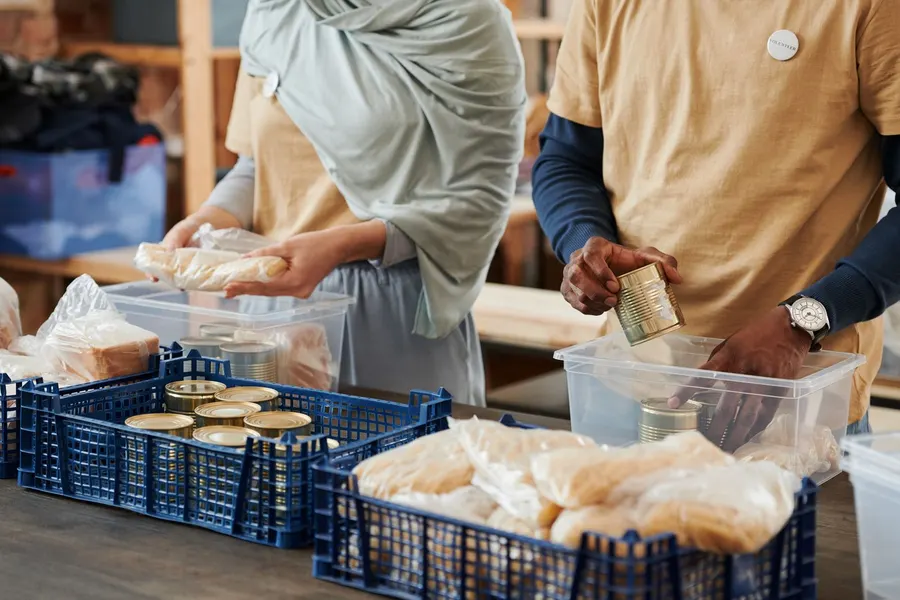
Food banks show up often. The written list includes San Diego Food Bank, Treasure Coast Food Bank (Florida), Second Harvest Food Bank (Indiana), Community Food Bank of New Jersey, Mid-South Food Bank (Tennessee) and Bellingham Food Bank (Washington). If your food bank is not listed, ask anyway.
What to Ask When You Call
There is no national application, income limit or amount. Each program decides. Questions worth asking:
- Do you give period supplies to individuals, or only through partners like schools or shelters? (APS says members give “directly to individuals in need or through local community partners.”)
- What do I need to bring, if anything?
- What do you have right now — pads, tampons, liners?
- How often can I come back?
- Is there a time or place I can pick up without an appointment?
At School: Free Products in Some States
Some states now require public schools to stock period products. Two examples, read straight from state law:
- California: public schools with any of grades 3 to 12 “shall stock the school’s restrooms at all times with an adequate supply of menstrual products, available and accessible, free of cost, in all women’s restrooms and all-gender restrooms, and in at least one men’s restroom.” Each of those restrooms must post a notice with the email and phone number of the person in charge of keeping them stocked (Cal. Educ. Code 35292.6). If the restroom is empty, that notice tells you who to contact.
- Minnesota: schools “must provide students with access to menstrual products at no charge” in restrooms used by grades 4 to 12 (Minn. Stat. 121A.212).
APS counts 26 states and Washington, D.C. with school laws as of August 15, 2026, and says “the details of period products in schools legislation vary widely between states” (Period Products in Schools). We only checked California and Minnesota ourselves. If you have school-age kids, see also our school meals guide.
If You Have an HSA or FSA
This will not help everyone, but it is little known. Since 2020, federal tax law treats “menstrual care products” as medical care for health savings accounts (26 U.S.C. 223) and for employer health plans such as FSAs and HRAs (26 U.S.C. 106(f)). The law spells out “a tampon, pad, liner, cup, sponge, or similar product.” IRS Publication 969 (2025) confirms they are “a covered expense” for FSAs and HRAs.
If your job offers an FSA card, you may be able to use it for these products. Check with your plan.
Programs to Line Up at the Same Time
- Diaper banks — many period supply programs are run by diaper banks, so one call can cover both.
- SNAP — it can’t buy pads, but it frees up grocery money.
- WIC — for pregnant people, new parents and children under 5.
- Help for single mothers — a round-up of programs for one-parent households.
How We Checked This
What we opened and read ourselves, on September 15, 2026. The Alliance for Period Supplies Get Help, Allied Programs, Our Work and Period Products in Schools pages. The raw data behind the allied member map, which we downloaded and counted pin by pin. The 2021 survey data set APS posts. The federal rules 7 CFR 271.2 and 7 CFR 246.2 (title 7 issue of September 9, 2026) and 45 CFR 260.31 (title 45 issue of August 31, 2026), pulled through the eCFR’s own API. 26 U.S.C. 223 and 106 from the 2024 U.S. Code, and IRS Publication 969. California Education Code 35292.6 and Minnesota Statutes 121A.212.
Something you only see in the source itself. The allied member map is not one list — it has a second layer of 50 “NDBN members w period supply programs” that never appears in the written list. In four states (West Virginia, Oregon, South Dakota and Wyoming), the written list shows no local program, but the map shows one. If you only read the list, you would think there is nothing near you.
Where the common belief and the source do not match.
- “38% of low-wage working women miss work because they can’t get period products.” The APS page says “Over one-third (38%) of low-wage working women report missing work, school or similar events.” The survey data set it links to says something broader: “One-third (38%) of people who menstruate have had to miss events or activities in the last year.” It does not limit that figure to low-wage working women. We use the data set’s wording. The survey is from 2021, was run by YouGov for U by Kotex (the founding sponsor of APS), and asked 1,036 adults. It also found that only 4% knew of a local resource with period products at reduced or no cost — in both 2018 and 2021.
- “California schools only have to stock pads for grades 6 to 12.” That is how the APS schools page still describes California’s 2021 law. The current code section, operative July 1, 2024, covers schools with any of grades 3 to 12.
- “FSA and HSA money can only go to prescriptions and doctor visits.” Not since 2020. Menstrual care products are written into the tax code for HSAs, FSAs and HRAs.
- “SNAP can’t buy them because my state blocks it.” It is the federal definition of “eligible foods” that leaves them out, so the answer is the same in every state.
What we could not check.
- We did not call any program. We cannot tell you whether a program has supplies today, what it asks for, or how much it gives.
- We did not open 211.org or The Kwek Society’s site for this guide.
- State sales tax on period products (“tampon tax”): we did not verify any state’s rules from a state tax agency, so we give no state list or rates.
- School laws in other states: we read only California’s and Minnesota’s. The count of 26 states plus D.C. is APS’s, not ours.
- fns.usda.gov blocks our requests (HTTP 403), so the SNAP and WIC points come from the regulations on eCFR instead.
The allied member list and map change as programs join and leave, so treat the exact counts as a September 15, 2026 snapshot. The durable point is to check both the list and the map, then call 2-1-1.
The Alliance for Period Supplies is a nonprofit program of the National Diaper Bank Network, not a government agency. Locations, supplies and rules vary by local program. Federal rules above apply nationwide; school rules shown are for California and Minnesota only.
Last updated: September 15, 2026
This is general information, not legal or financial advice.
Frequently Asked Questions
Can I buy pads or tampons with SNAP (food stamps) or WIC?
No. The federal rule, 7 CFR 271.2, limits SNAP to "any food or food product intended for human consumption," plus a short list of exceptions such as seeds and certain meals. Pads, tampons and cups are not food. WIC is even narrower: its benefits buy "supplemental foods," which 7 CFR 246.2 ties to food packages the USDA prescribes. That is why separate nonprofit programs exist to give out period supplies.
How do I find free period supplies near me?
The Alliance for Period Supplies says to call 2-1-1 or search 211.org and ask for "period supplies or basic needs," and to check listings under "women, girls, families, or transgender individuals." Its allied-programs page adds more search words: "feminine hygiene products," "hygiene items," "personal hygiene items," "sanitary napkins," and "tampons." You can also check the state-by-state allied member list and map, and local faith-based organizations and food pantries.
Do I have to prove my income to get period supplies?
There is no national rule. Allied members of the Alliance for Period Supplies "are independently operated nonprofit organizations," so each one sets its own process. Some give supplies directly and some work through partners like schools or pantries. Ask the program what it needs from you before you go.
My state shows no program on the list. What now?
Look at the map too. On September 15, 2026, the written list said "There are currently no allied programs" in Delaware and West Virginia, and showed only The Kwek Society (listed for "Native American educators and organizations") in Montana, North Dakota, Oregon, South Dakota and Wyoming. But the map on the same page had a pin in West Virginia, and its second layer, "NDBN members w period supply programs," had pins in Oregon, South Dakota and Wyoming. Then call 2-1-1, and ask your food pantry.
Can I use an HSA or FSA to buy pads and tampons?
Yes, if you have one. Federal tax law says amounts paid for "menstrual care products" count as medical care for health savings accounts (26 U.S.C. 223) and for employer health plans like FSAs and HRAs (26 U.S.C. 106(f)). The law defines them as "a tampon, pad, liner, cup, sponge, or similar product." IRS Publication 969 (2025) says the same. This applies to expenses after December 31, 2019.
Do schools have to give out free period products?
Some do, depending on the state. California law requires public schools with any of grades 3 to 12 to stock menstrual products "free of cost" in all women's and all-gender restrooms and at least one men's restroom. Minnesota law requires no-charge access in restrooms used by grades 4 to 12. The Alliance for Period Supplies counts 26 states and Washington, D.C. with school laws as of August 15, 2026, but the details vary a lot. Ask the school nurse or front office.
Sources
- Alliance for Period Supplies — Get Help, read September 15, 2026 ("If you or someone you know needs period supplies, there may be assistance in your town."; call 2-1-1 or go to 211.org; "Ask about or search for period supplies or basic needs."; "Also check the listings under women, girls, families, or transgender individuals."; "If you still can't find a resource, try local faith-based organizations and food pantries.")
- Alliance for Period Supplies — Allied Programs, read September 15, 2026 (allied members "collect, warehouse, and distribute menstrual and period supplies in local communities" and "are independently operated nonprofit organizations"; state-by-state written list and embedded Google map; 211 search keywords "feminine hygiene products, hygiene items/supplies, personal hygiene items/supplies, sanitary napkins, period supplies, or tampons"; "There are currently no allied programs in Delaware." / "in West Virginia.")
- Alliance for Period Supplies — Allied member map data (Google My Maps layers "Allied Programs" and "NDBN members w period supply programs"), downloaded and counted September 15, 2026
- Alliance for Period Supplies — Our Work, read September 15, 2026 ("an initiative of the National Diaper Bank Network (NDBN) – a 501(c)(3) nonprofit organization"; "Launched in May 2018"; "our allied members distribute period supplies directly to individuals in need or through local community partners")
- U by Kotex Period Poverty Awareness Week – Survey Results (online survey conducted by YouGov on behalf of U by Kotex, 1,036 U.S. adults who regularly experience a period, fielded April 22-28, 2021; "four out of ten (42%) respondents say they have at some point in their life struggled to purchase period products due to lack of income"; "over one-third (35%) of people who menstruate reported having to use a substitute period product"; "only 4% of respondents said to know of a local resource that provides period products at a reduced cost or no cost"), PDF posted on allianceforperiodsupplies.org
- 7 CFR 271.2 — SNAP definition of "Eligible foods" (paragraph (1): "Any food or food product intended for human consumption except alcoholic beverages, tobacco, and hot foods and hot food products prepared for immediate consumption"), eCFR title 7 issue of September 9, 2026
- 7 CFR 246.2 — WIC definition of "Supplemental foods" ("those foods containing nutrients determined by nutritional research to be lacking in the diets of pregnant, breastfeeding and postpartum women, infants, and children ... as prescribed by the Secretary in § 246.10"), eCFR title 7 issue of September 9, 2026
- 45 CFR 260.31 — What does the term "assistance" mean? (TANF) ((a)(1): "cash, payments, vouchers, and other forms of benefits designed to meet a family's ongoing basic needs (i.e., for food, clothing, shelter, utilities, household goods, personal care items, and general incidental expenses)"), eCFR title 45 issue of August 31, 2026
- 26 U.S.C. 223 — Health savings accounts ((d)(2)(A): "amounts paid for menstrual care products shall be treated as paid for medical care"; (d)(2)(D): "the term 'menstrual care product' means a tampon, pad, liner, cup, sponge, or similar product used by individuals with respect to menstruation or other genital-tract secretions"), U.S. Code 2024 edition on govinfo.gov, read September 15, 2026
- 26 U.S.C. 106 — Contributions by employer to accident and health plans ((f): "expenses incurred for menstrual care products (as defined in section 223(d)(2)(D)) shall be treated as incurred for medical care"; amendment by Pub. L. 116–136 applies "to expenses incurred after December 31, 2019"), U.S. Code 2024 edition on govinfo.gov, read September 15, 2026
- IRS Publication 969 (2025), Health Savings Accounts and Other Tax-Favored Health Plans, read September 15, 2026 (HSA: "Amounts paid for menstrual care products are treated as paid for medical care."; FSA and HRA: "Expenses incurred for over-the-counter medicine (whether or not prescribed) and menstrual care products are considered medical care and are considered a covered expense.")
- California Education Code section 35292.6, read September 15, 2026 (public schools "maintaining any combination of classes from grades 3 to 12, inclusive, shall stock the school's restrooms at all times with an adequate supply of menstrual products, available and accessible, free of cost, in all women's restrooms and all-gender restrooms, and in at least one men's restroom"; schools must post a notice with "contact information, including an email address and telephone number, for a designated individual"; operative July 1, 2024)
- Minnesota Statutes section 121A.212, Access to Menstrual Products, read September 15, 2026 ("A school district or charter school must provide students with access to menstrual products at no charge. The products must be available to all menstruating students in restrooms regularly used by students in grades 4 to 12")
- Alliance for Period Supplies — Period Products in Schools, read September 15, 2026 ("Currently, 26 states and Washington D.C. have active legislation to help students who menstruate have free access to period products while in school (as of August 15, 2026).")
Keep reading
- Find a Food Bank Near You: Feeding America Guide (2026) Free groceries through 250+ food banks and 60,000+ local pantries Read guide →
- Diaper Bank Near You 2026: Get Diapers & Who Qualifies SNAP and WIC cannot buy diapers — diaper banks give them out at no cost Read guide →
- Government Help for Single Mothers 2026: Where to Start No program is named "for single mothers" — but a mother of two can qualify for Medicaid up to about $37,702 a year, WIC until each child turns 5, and child care help while she works or studies Read guide →
This is general information, not legal or financial advice.